Which of the Following Is One of the Ways That a Company Can Achieve a Cost Advantage by Revamping
Researching our doctors. Recycling. Furthering your didactics. We're doing all the correct things. So why are these companies taking advantage of so many of us?
The Recycling Myth
Remember you know where your old plastic ends upward?
Once a week, you dutifully set up out your bin full of recyclables for collection. You're happy to practise your part for the environs because plastic, which is derived from fossil fuels, contributes to pollution and climate change. And while it has its good points—plastic is both lightweight and durable, saving fuel in transport—the best thing about information technology is that it's easily recycled. Now, about that…
In fact, over the past iv decades, less than 10 percentage of all plastic in the United States has been recycled. Some items are reused more than than others. We repurpose about 30 percent of used water, soda, shampoo, and bleach bottles. But that notwithstanding leaves seventy percentage piling up in dumps, or worse. China, the biggest market for our old plastic, stopped importing it birthday in 2018. While consumers may well exist ignorant of this fact, the plastics manufacture is not. NPR, working with the PBS series Frontline, recently dug up reports sent to industry executives that chosen recycling plastic "costly … difficult … infeasible." And this was way back in the 1970s and '80s! "There was never an enthusiastic belief that recycling was ultimately going to piece of work in a pregnant way," Lew Freeman, former vice president of the industry'south lobbying group, the Guild of the Plastics Industry (SPI), now the Plastics Industry Association, told NPR and Frontline.
Though not much has changed since those reports were written, the plastics industry continues to shovel millions of dollars into promoting recycling via ads and didactics. Why? Public relations. "If the public thinks the recycling is working, then they're non going to exist as concerned nigh the environment," says Larry Thomas, another one-time SPI executive.
Communities have to do something with all that unrecycled plastic. That oft means called-for it with the rest of the trash. "About six times more postconsumer plastic waste material is burned in the Usa than is domestically recycled," reports the Plastic Pollution Coalition, while the Middle for International Environmental Law points out that producing and incinerating plastics will add more than 850 million metric tons of greenhouse gases to the atmosphere annually, "an amount equal to the emissions from 189 500-megawatt coal power plants."
That's probably non what you're thinking when you lot haul your bottles to the adjourn. Here'southward how one woman went plastic-free and what she uses instead.

Corporate Welfare
Some companies profited off a pandemic.
You're a small-business organisation owner forced to shut down for a time during the COVID-19 pandemic. You lot're worried nearly your employees. If you lay them off, how will they alive? But and then you hear that Washington has approved the Paycheck Protection Program (PPP). It's designed to provide an incentive for pocket-sized businesses to go along paying their workers' salaries by lending the owners coin—which they don't demand to pay back if the bulk is put toward payroll and other costs. Perfect!
At 12:01 a.m. on April 3, the very first minute of the program, you apply for a loan online and wait for the check to come. And then you lot wait a bit more. Until xiii days later, when you detect that the $349 billion emergency funding is completely tapped out. Not only that, but but a measly v per centum of small businesses that applied really received loans.
So who got the checks? Let's come across: Ruth's Chris Steak House, Milk shake Shack, AutoNation… As it turns out, 440 loans bypassed small-scale businesses and went to large publicly traded corporations, many of which had the wherewithal to raise capital without a helping hand from the feds.
While those 440 loans accounted for only 1.5 per centum of the 25,000 loans granted, many were for large sums—for example, AutoNation was given $77 million. Individual loans of over $two million each sucked up a quarter of the full pool of coin. A second round of loans was more stringent. Still, loans for $two million–plus made up 16 percent of the total sum.
"It's outrageous," Amanda Ballantyne of Master Street Alliance, an advocacy group for modest businesses, told the New York Times. Endless small-business organisation owners "have laid off all their staff and will go bankrupt because of the problems with the way the PPP was designed."
So how did this mess happen? To become the coin to applicants quickly, the government had the Minor Business organisation Administration guarantee the loans, only banks distributed them. The banks decided which companies got funding, and they often favored their best customers. According to NPR, the average PPP loan at large banks was over $90,000. At small banks, it was $58,000. Every bit a result, Escalade Sports, which makes Ping-Pong tables, basketball hoops, and the like, got $5.6 million even with a "$50 1000000 credit line from JPMorgan Chase" and after reporting it saw "ascension need for its products, with so many Americans cooped up in their homes," says the New York Times.
A similar program saw the Department of Wellness and Human Services disburse billions to distressed hospitals. Amidst the "distressed" hospitals was Rise Wellness, which operates 150 hospitals nationwide. It received $211 meg…fifty-fifty though it operates its ain venture upper-case letter fund.
Hospitals that serve a greater proportion of wealthier, privately insured patients got twice every bit much relief as those focused on low-income patients with Medicaid or no coverage at all. In other words, the hospitals that needed the money most got the least. That includes St. Claire HealthCare, the largest rural infirmary system in eastern Kentucky. The $3 million the hospital received in Apr barely covered 2 weeks of payroll, primary executive Donald H. Lloyd II told the Times. The loan, he said, "is just a Ring-Aid."
Taxpayer outrage triggered a game of corporate mea culpa, resulting in 69 large companies returning the loans. As of September i, of the $1,390,298,467 doled out to publicly traded companies, $436,477,630 had been returned, according to factsquared.com, a data analysis website. The offset was Shake Shack, which sent back its $10 million check, followed by AutoNation, Ashford Hospitality Trust ($45.ix million), and Ruth's Hospitality Grouping, owners of Ruth's Chris ($twenty million).
Still, virtually companies kept the money, citing the uncertain economic system. Which is just wrong, treasury secretarial assistant Steve Mnuchin said on CNBC. Even though somewhen nigh of the pocket-sized businesses that applied for PPP loans concluded up receiving them, "The purpose of this program was not social welfare for big business organisation." Here are 18 things you tin still practise to support your favorite small businesses.

Surprise Medical Billing
The real hurting comes later the functioning.
You're about to take minor surgery, and so of class you practise your homework. Present that means you non simply make sure that your surgeon and hospital have good track records; yous make certain that they both take your insurance as well.
You wake up from the procedure to discover that everything went great—except that the hospital-assigned anesthesiologist who put you under is non in your insurance network and you are stuck paying his bill in full.
Welcome to the Surprise Medical Neb. Actually, surprise might not be the correct word, given that nigh xx percent of all surgical patients will receive one. For them, the "surprise" can soar to around $14,000 in out-of-network costs. No wonder 137 million Americans are mired in medical debt. The infuriating factor here is that the majority of those folks (about 63 percent) had wellness insurance when treatment began. Isn't this why we have wellness insurance—to pay the bills?
Studies from Yale and the Journal of the American Medical Association have institute that the surprise bills come typically from anesthesiologists and surgical administration, specialists that patients rarely select personally. They are brought in by the surgeons or the hospital—the very ones who should know who or what is covered past a patient's insurance. A Yale study institute that up to 12.3 per centum of cases involving a pathologist, an anesthesiologist, an assistant surgeon, and a radiologist were billed out of network. In contrast, orthopedists performing knee replacements—a service for which a patient tin can choose an in-network physician alee of time—billed out of network less than 1 percent of the time.
"The ability to bill out of network allows specialists to negotiate inflated in-network rates, which are passed on to consumers in the class of higher insurance premiums," Zack Cooper, an associate professor at the Yale School of Public Health, told Yale News.
How much more? According to the periodical Wellness Affairs, in-network rates for banana surgeons were 176 percent of the Medicare-negotiated fee; for anesthesiologists it was 367 percent. The out-of-network rates: 802 per centum of the Medicare rate for anesthesiologists and 2,652 pct for banana surgeons.
Terminal yr, Congress proposed legislation assuasive patients receiving care at in-network hospitals to pay only the in-network toll, even if an private doctor is out of network. Patient advocates are eager to run across it approved. After all, it'southward a clear thing of fairness. "You don't choice these people. You don't know them," Karen Pollitz, a senior young man at the Kaiser Family Foundation, told the Atlantic. "You learn their name when the bill comes."
For-turn a profit Colleges
An education on scams.
You make up one's mind to enroll in a individual for-profit college. The school is not as cheap equally a public university, simply its job-specific programs and flexible schedule suit your work hours. As well, the impressive job-placement rate it boasts makes you optimistic that you might just find that higher-paying chore. And so you graduate, and you discover that y'all may have been cheated.
According to the Century Foundation, a public-policy enquiry institution, 98 pct of all fraud complaints confronting colleges are brought against for-profit schools. Amidst them is Career Education Corporation (now called Perdoceo Teaching Corporation), which operates Colorado Technical University and American InterContinental Academy. In 2019, the visitor agreed to cancel $493.7 million in student debt for nearly 180,000 one-time students. Forbes said investigations by states' attorneys general and the U.S. Senate constitute that Career Education deceived students about the total costs of enrollment; misled students almost the transferability of credits; and failed to disclose that certain programs lacked the necessary accreditation.
The scandals didn't start with Career Pedagogy. In 2016, the largest for-profit educator, ITT Tech, was forced to shut afterward it was learned that the school had lured students with exaggerated graduation and job-placement figures. Dream Centre Education Holdings shut 41 campuses under the names the Fine art Institutes and Argosy Academy later improperly withholding millions in fiscal aid from students, including veterans on the GI Pecker.
At least these schools had teachers. Reagan National Academy in Sioux Falls, S Dakota, was accredited to teach in 2017, withal as of this past Feb, information technology had no students, no kinesthesia, and no classrooms, co-ordinate to a articulation report in Us Today and the Argus Leader. What it does have is a link to the Academy of Northern Virginia, a suspected "visa mill" (a school that functions primarily to permit foreign students enter the U.s.).
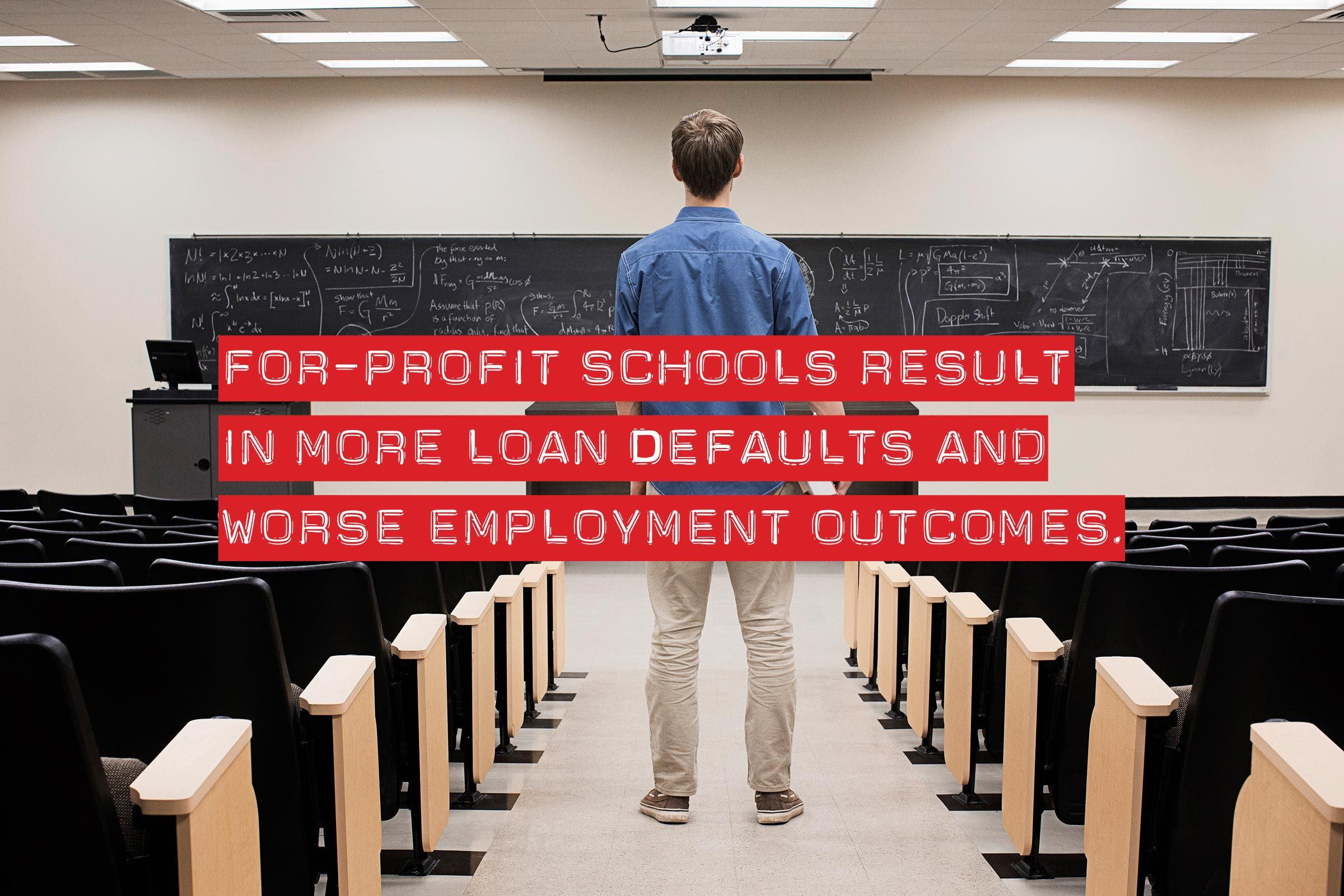
Information technology doesn't get much amend for students should they really graduate. As U.Due south. News & World Report points out, "degrees conferred by for-turn a profit colleges often practise non produce the earning power graduates hope to achieve" nor "the same educational quality they may expect at nonprofit colleges." As such, students have difficulty finding jobs, let solitary high-paying ones, which leads to trouble paying off loans. The National Bureau of Economical Enquiry found that while just 6.7 percent of all college students were enrolled in a for-profit school, they fabricated upwardly 39 per centum of college students who defaulted on their federal loans.
Information technology's no wonder that amid the more than i,230 campuses that airtight over the past five years, 88 percentage were operated by for-profit colleges. According to the Chronicle of College Education, roughly 450,000 displaced for-turn a profit higher students, many of whom are working adults living paycheck to paycheck, had their hopes to reach the American dream derailed.
"One class left," read a quote in the Chronicle from Lisa La More'south Facebook folio subsequently the Art Institute of California's San Diego campus shut downwardly recently. "Less than iii weeks from my BS in Graphic and Web. Six years of my life wasted. I am 48 years old, with teenage kids. What am I supposed to practice now?" Next, hither's what colleges could expect similar when they reopen from the pandemic.
Source: https://www.rd.com/article/these-companies-are-taking-advantage-of-you/

Post a Comment for "Which of the Following Is One of the Ways That a Company Can Achieve a Cost Advantage by Revamping"